
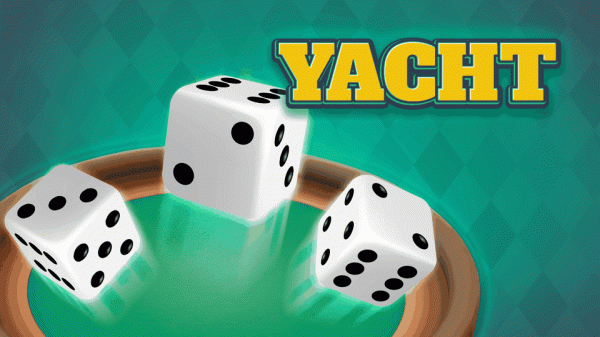
Rolling and Locking Dice
Each turn begins with five dice on the table. You roll them, then decide which results to lock in place and which to reroll. You get three rolls per turn, so the first roll is a starting point, not a commitment. Locking a die removes it from the next roll, which means every choice narrows what you can still achieve. The tension comes from knowing when to settle for a decent result and when to push for a better one with fewer dice.
The Scorecard Categories
Points come from filling thirteen categories, each usable only once per game. The upper section covers ones through sixes, where you score the total of matching dice. The lower section includes three of a kind, four of a kind, full house, small straight, large straight, and Yacht, which is five of a kind. Because every category can only be claimed once, late-game turns often force you to choose between a weak score now or a risky attempt at a high-value combination.
Upper Section Bonus
Filling the upper section early has a practical benefit: if your ones through sixes total at least 63 points, you earn a bonus. That threshold encourages players to prioritize matching dice in the first half of the game rather than chasing lower-section combinations immediately. Ignoring the upper section until the end usually means accepting zeros or low scores there, which can erase the advantage of a lucky Yacht.
Playing Solo or with Friends
The game runs entirely in a web browser with no download or installation. You can play alone to practice decision-making or compete with friends for the highest total. Click-to-lock controls keep the interface simple, and the scorecard tracks progress across rounds. The mix of luck and planning means a single lucky roll can change the outcome, but consistent category management usually decides who wins.






Comments
0 comments