
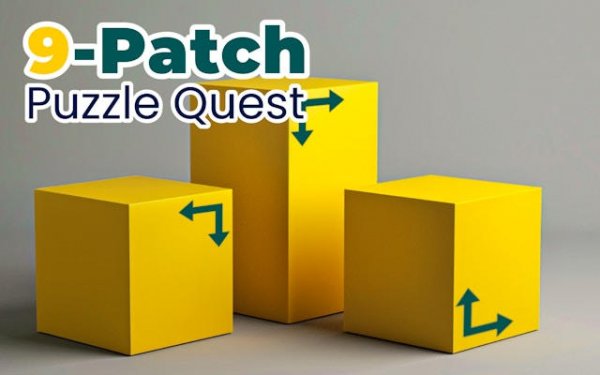
What You Actually Do
Each stage hands you an empty grid and a set of numbered squares. Your job is to place every square so that it occupies its own cells and overlaps nothing else. The level is complete only when the grid is entirely filled. There is no timer and no penalty for rearranging, so the pressure comes from the layout itself rather than from speed.
Why Order Matters
Patch Grid Puzzle is not a game of random dragging. The sequence in which you place pieces changes what remains possible. A square that fits early can block a later one, and a grid that looks nearly solved can become unsolvable after one careless placement. Successful players study the board before touching a piece, then work from the most constrained areas outward. When a layout fails, the fix is usually a different starting point rather than a different piece.
Level Variety and Difficulty
The game ships with 30 unique stages. Grid shapes change from level to level, and the piece sets become more varied as you progress. Early boards are small enough to solve by trial, while later ones demand real forethought about how each square consumes space. That gradual curve keeps the game approachable for casual players without flattening it for puzzle veterans.
Controls and Pace
Drag-and-drop is the only input you need, and the interface stays out of the way. Because there is no rush, sessions can be as short as a single puzzle or as long as a full run through the later stages. The appeal is the same either way: a quiet, self-paced mental workout built on one clean rule.




Comments
0 comments