
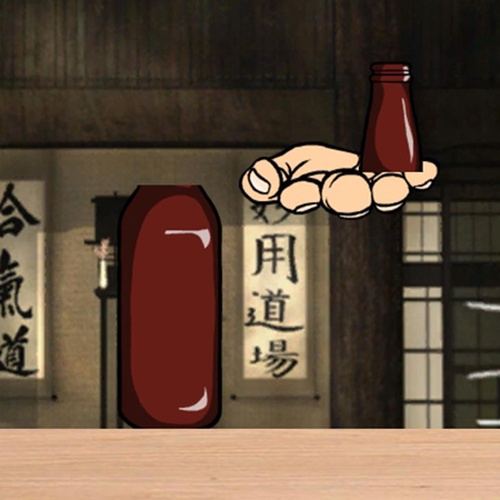
Core Motion Mechanics
At the heart of this experience lies a simple input system: your cursor directly moves an on-screen hand. The objective is to align that hand with a bottle cap and perform a clean slicing motion. Success depends on two factors: positioning accuracy and the speed of your swipe. The game provides immediate visual feedback after each attempt, letting you see exactly where your motion succeeded or fell short. This loop of aim, slice, and review forms the entire gameplay cycle, making it easy to understand yet demanding to perfect.
Visual Clarity and Focus
The design philosophy here prioritizes minimalism. Backgrounds are kept plain, and the bottle and hand are rendered in clean, flat colors. This lack of visual clutter helps players concentrate entirely on the task at hand. There are no distracting animations, pop-ups, or score multipliers vying for attention. The interface shows only your current score and a simple reset option. This stripped-down approach means the game works well on small screens or in low-light environments where extra graphics could cause strain.
Progression Through Repetition
While the core action remains constant, the challenge evolves through subtle changes in bottle positioning. Early attempts place the bottle in a central, easy-to-reach spot. Later rounds may shift it to the edges of the screen or rotate it slightly, requiring finer adjustments. The game does not introduce new tools or power-ups; instead, it relies on your growing familiarity with the cursor-to-hand mapping. This gradual increase in difficulty keeps the experience fresh without overwhelming new players. Each successful slice feels earned through practice rather than luck.
Accessibility Across Devices
The control scheme works equally well with a mouse, trackpad, or touchscreen. On desktop, a steady hand with the mouse yields the best results. On tablets or phones, the direct touch input feels intuitive, as your finger becomes the hand. The game does not require fast reflexes or complex button combinations, making it suitable for younger children and older adults alike. Sessions can last anywhere from thirty seconds to thirty minutes, depending on your desire for precision. There is no time limit or penalty for slow movements, encouraging a patient, methodical approach.
Scoring and Self-Improvement
Points are awarded based on the cleanliness of each slice. A perfect cut near the cap's edge yields a higher score than a messy, off-center one. The game tracks your total score across a session, but does not store high scores between visits. This design choice reduces pressure and lets you focus on personal improvement rather than competition. The lack of leaderboards or achievements means the only opponent is your previous best. For players who enjoy tracking progress, a simple mental note of your streak of perfect slices can serve as a satisfying benchmark.








Comments
0 comments